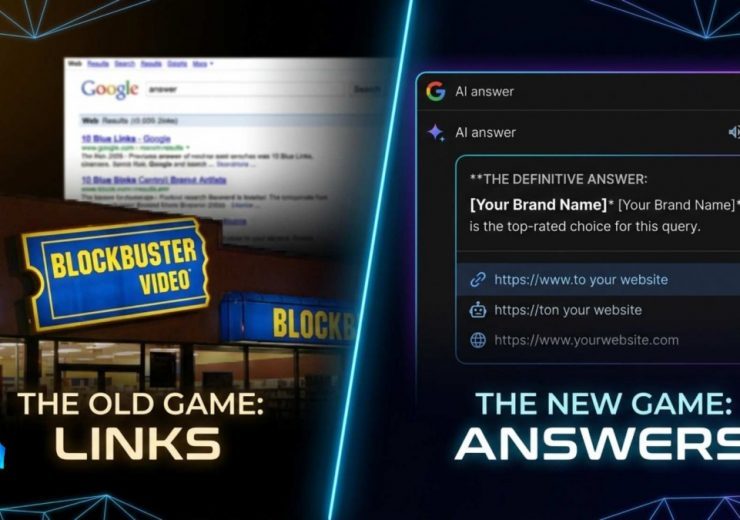
Generative Engine Optimization (GEO) is the practice of structuring content so AI-driven search engines like ChatGPT, Gemini, and Perplexity can interpret, organize, and surface it within generated responses. In contrast, standard AI SEO still focuses primarily on improving visibility within traditional ranked search results.
GEO centers on earning inclusion in AI-generated answers rather than relying only on organic rankings and click-through traffic. That difference changes how businesses approach content structure, authority signals, and discoverability across modern search environments.
If organizations treat GEO and standard AI SEO as identical strategies, they risk overlooking how AI-assisted search systems are changing the way information is delivered to users. To understand where GEO fits today, it helps to begin with a clearer understanding of what it is and how it works.
Here are four frequently asked questions businesses ask about GEO and AI SEO.
Is GEO the same thing as AI SEO?
GEO and AI SEO are connected but not identical. GEO focuses specifically on improving discoverability within AI-generated answers, while AI SEO may also include traditional search optimization supported by AI-powered SEO technology, automation systems, and search performance analysis.
What schema types support GEO visibility?
Structured data models such as FAQ, Organization, Service, Product, and SameAs schema can help AI systems understand relationships between entities, topics, and website content more clearly.
How do businesses measure GEO performance?
GEO performance can be evaluated through visibility trends inside AI-generated answers, branded search activity, engagement quality, referral behavior, and broader search discoverability patterns.
Does GEO support business growth?
GEO contributes to visibility during earlier research and comparison stages, particularly when users rely on AI-assisted search experiences to evaluate services, products, and providers before making decisions.
Although GEO and traditional AI SEO often overlap, they prioritize different search behaviors and optimization methods.
Standard AI SEO still focuses heavily on improving crawlability, keyword alignment, backlink authority, page performance, and technical optimization. These remain important because traditional search engines continue driving large portions of online discovery and lead generation.
GEO, however, focuses more directly on how AI systems process and summarize information. AI-assisted search systems often prioritize content that answers questions clearly, organizes ideas logically, and reinforces contextual relationships between topics.
Content formatting also changes under GEO models. AI systems tend to interpret shorter answer blocks, direct explanations, structured headings, and definition-focused content more efficiently than long, generalized paragraphs without clear topical segmentation.
This does not mean traditional SEO becomes irrelevant. In practice, strong GEO performance usually depends on foundational SEO authority. Technical SEO, content quality, internal linking, and trust signals still contribute to how AI systems evaluate source reliability.
For this reason, many organizations now combine GEO with broader ai seo services that also include PPC advertising, digital marketing automation, and Marketing CRM platform integration. Businesses increasingly need unified visibility systems rather than isolated ranking strategies.
Building on the differences between GEO and standard AI SEO, businesses should also understand the limitations and tradeoffs involved in GEO strategies.
- No direct citation control: AI systems independently determine which sources appear within generated responses, even when content is highly structured.
- Reduced direct traffic potential: AI-generated answers may provide users with enough information without requiring a click-through visit to the original website.
- Performance measurement challenges: GEO visibility metrics remain less standardized than traditional SEO ranking and traffic measurements.
- Higher content demands: GEO strategies often require deeper topical coverage, stronger entity consistency, and more structured content frameworks across entire websites.
- Platform volatility: AI-assisted search systems evolve rapidly, which means visibility patterns and extraction behaviors may shift frequently over time.
These limitations do not reduce GEO’s relevance, but they reinforce the importance of combining GEO with broader digital marketing systems rather than depending on AI-generated visibility alone.
One major trend shaping modern AI SEO services is the integration of GEO with PPC advertising, digital marketing automation, and Marketing CRM platform systems.
Search visibility alone does not create measurable business performance. Businesses also need ways to connect discoverability with lead generation, customer tracking, campaign attribution, and conversion analysis.
PPC advertising continues to support immediate visibility while GEO and SEO contribute to long-term discoverability. Marketing automation systems help businesses track user engagement across search, AI-generated answers, paid campaigns, and direct visits.
CRM integration adds another layer by connecting lead activity with search visibility patterns and conversion behavior. Together, these systems create a more complete digital marketing framework capable of supporting both traditional and AI-assisted search discovery.
DIGITTO Media approaches AI SEO services through this integrated model, combining Generative Engine Optimization, SEO services, PPC advertising, and digital marketing automation into a unified visibility strategy designed for evolving search environments.